
News
The competition in the large-scale commercial laundry track has long moved beyond efficiency contests in the washing and extracting stage. Managers of many large central laundry plants share the same confusion: washing and extracting units run at full load with maximum linen cleaning efficiency, yet the follow-up ironing and folding procedures frequently slow down the pace of the entire production line. Large fabrics such as quilt covers, bed sheets and tablecloths pile up in the waiting area. Manual spreading takes plenty of time and effort, while ordinary ironing equipment leads to flaws like uneven wrinkles and inconsistent dampness due to uneven heating, which silently erode the operating profits of the plant. Can the backend ironing unit only become a weak short board in the laundry production line?
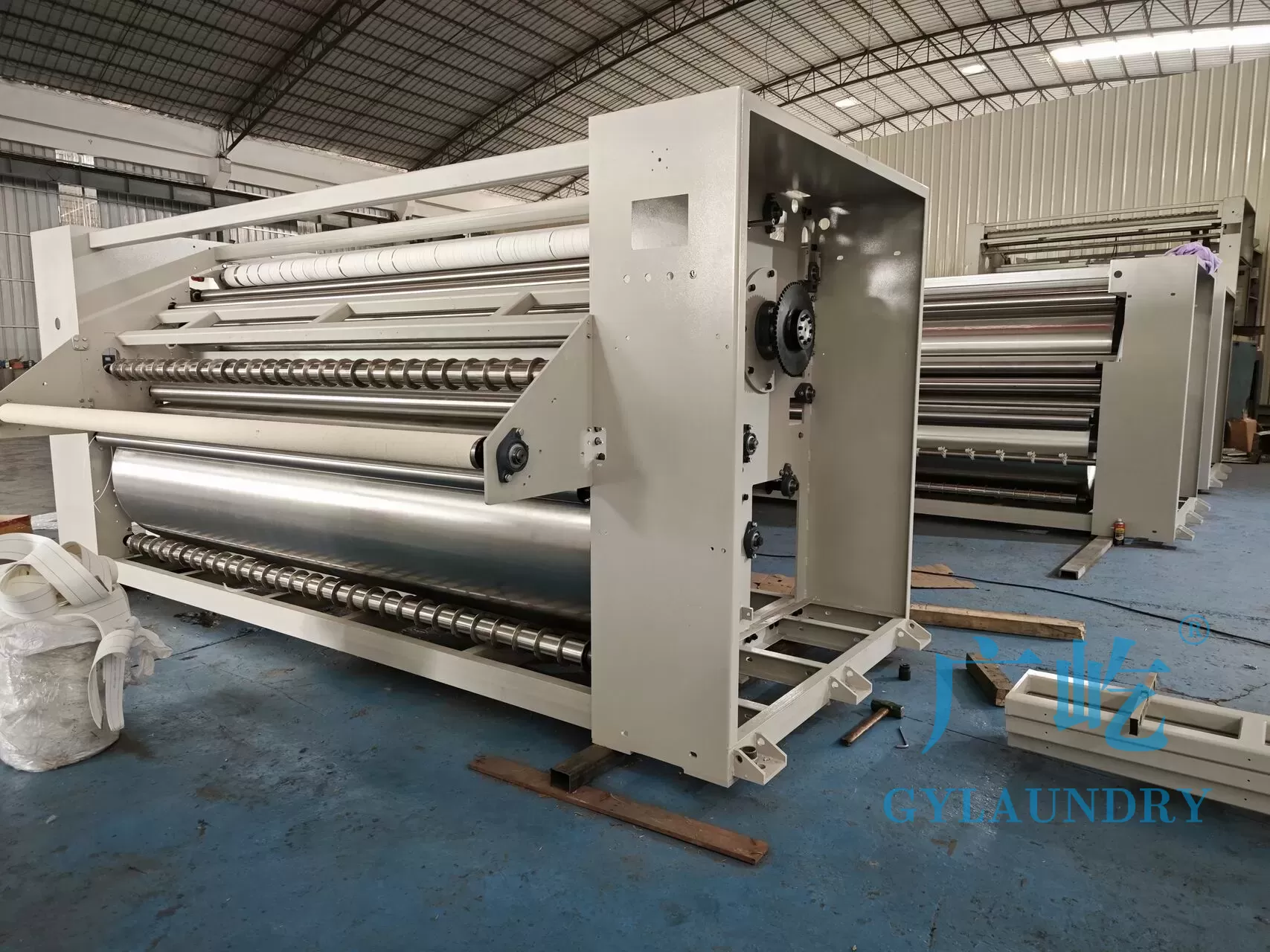
Practitioners deeply engaged in the R&D of commercial laundry equipment clearly know that a high-performance high-speed flatwork ironer can completely reverse the operating status of the entire linen processing chain. The GYP6-7033 six-roll high-speed flatwork ironer dissected in this paper is a robust device polished to address the pain points of batch linen ironing in large laundry plants. It integrates the three core demands of high efficiency, energy saving and stability into every structural design of the machine body, and also lets us see the core direction of iteration for current industrial ironing equipment.
The fabric passing structure directly determines the ironing flatness of linens. What kind of practical differences can the S-shaped fabric passing path equipped on this device bring? Most conventional flatwork ironers adopt a single-layer one-way fabric feeding mode. Fabrics tend to shift after single-sided heating, resulting in uneven edges when ironing multi-layer quilt covers. The reciprocating S-shaped fabric passing design enables the front and back sides of linens to fully fit the high-temperature rollers for full heat coverage. Thick multi-layer fabrics such as hotel linens, hospital beddings and catering tablecloths can achieve smooth finished products in one pass, requiring almost no secondary manual trimming in the subsequent folding process. Another thoughtful highlight lies in its compatibility with steam working conditions. Many small and medium-sized laundry plants suffer from frequent fluctuations in boiler steam pressure, which easily causes start-stop jams of flatwork ironers. This machine can still operate stably under low steam pressure of 0.1MPa. Isn’t it a practical design that lowers the threshold for washing factories with imperfect supporting boiler facilities?
The material selection of the machine body best reflects the durability of industrial equipment. The left and right wall panels of the machine are integrally made of 12mm thick high-quality carbon structural steel. The heavy steel frame firmly absorbs vibration generated during high-speed operation of six groups of rollers, avoiding shaking and displacement of the machine body after long-term non-stop continuous operation. The core internal ironing rollers also reach a thickness of 12mm with sufficient heat storage volume to output stable heat for high-speed ironing continuously. Cast with special boiler alloy steel, the rollers deliver twice the thermal conductivity of ordinary stainless steel rollers without heat transfer interruption, preventing partial scorching from overheating or wrinkling caused by insufficient temperature on linens.
Four groups of elastic pressure rollers installed at the feeding inlet are an ingenious design to boost ironing capacity. Before wet washed linens enter the rollers, the pressure rollers squeeze and dehydrate the fabrics, removing up to 30% of residual moisture inside the textiles. The rollers no longer need extra heat to evaporate accumulated water, so the ironing speed rises significantly. The 270° large wrap angle design expands the contact area between linens and heating rollers by 10% compared with similar models on the market, delivering superior ironing flatness at the same running speed. The rollers can withstand pressure up to 10 kilograms, with safety valves fitted on pipelines to eliminate risks such as pipe rupture and pressure relief under high temperature and pressure, adding an extra layer of safety for frontline operators during long shifts.
Energy conservation and consumption reduction is an unavoidable topic for laundry enterprises to control operating costs, and this flatwork ironer has made numerous detailed optimizations in reducing heat loss. Thermal insulation layers wrap all steam transmission pipelines, outer roller walls, both ends of drying cylinders and the surrounding cabinet panels to lock internal high temperature and reduce outward heat dissipation, cutting overall steam consumption by 5%. The power system adopts a 3.75kW variable frequency motor with stepless speed regulation, supporting a maximum running speed of 60 meters per minute. Operators can flexibly adjust gears according to linen thickness and humidity, matching ideal ironing rhythms for thin napkins and thick quilts alike. Looking through the full set of core parameters: six rollers with 705mm diameter, 3300mm maximum ironing width, 400kg/h steam consumption, total weight of 13 tons and overall dimensions of 500044001900mm. The streamlined body can either be embedded into a fully automatic laundry tunnel washer for closed-loop supporting, or independently build a backend ironing and folding workstation, perfectly fitting diversified scenarios including hospital laundry centers, hotel linen outsourcing factories and large logistics laundry industrial parks.
The commercial laundry industry is steadily advancing toward intensification, low carbonization and full-link intelligence. Backend ironing equipment is no longer a negligible auxiliary unit in the production line, but a core hub that determines daily linen processing volume, finished product delivery quality and energy expenditure. To break through efficiency barriers across the entire laundry production process, selecting high-performance and highly stable ironing machinery and equipment is essential.
Deeply rooted in the R&D and manufacturing of industrial laundry equipment, Guangyi Intelligent keeps delivering solid structural craftsmanship and function development tailored to frontline working conditions, providing complete integrated backend ironing solutions for various large-scale laundry projects and empowering the commercial laundry industry to improve quality, lift efficiency and achieve sustainable development.

+86 135-3358-6618

1759543062@qq.com

No. 2, Xinghai Road, Lanhe Town, Nansha District, Guangzhou, China

Product
News Center
Copyright