
News
If you‘re running a laundry plant handling hotel linens, medical textiles, or industrial uniforms, the industrial washer is the heart of your operation. As the industry moves toward greater consolidation and smarter systems, one question keeps coming up among plant owners: should I go with traditional "fully automatic industrial washers" set up as separate units, or should I invest in washer-extractors that combine washing and dewatering in one machine?
On the surface, these two types of equipment might look similar. But get them into your plant and let them run for a few months, and the differences become obvious. Different designs, different workflows, and when you factor in utilities, labor, and return on investment, the gap only widens. Pick the right one, and your plant runs smoothly. Pick the wrong one, and you might find yourself stuck in an efficiency bottleneck before you even realize what happened.
Let‘s break this down. Looking at four key dimensions, we‘ll take a closer look at the fully automatic separate-unit washer and the washer-extractor—which one actually makes more sense? Hopefully, this helps you figure out the right fit for your business.
1. Structural Design: One Takes Up Space, the Other Cuts Out a Step
Let‘s start with the fully automatic industrial washer—what we typically call a washer-only unit. This setup separates washing from dewatering. After finishing a wash cycle, you have to manually pull the linens out and load them into a separate dewatering or press unit. In other words, it‘s a two-step process.
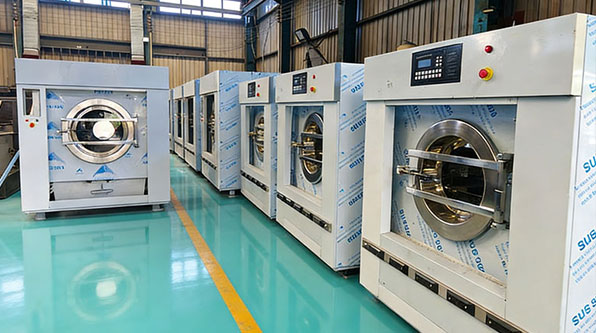
A washer-extractor simplifies things. A single drum handles everything—from water intake and washing all the way to high-speed extraction. The linens never leave the machine. The motor kicks in, pulling G-forces of 300 to 600, and moisture levels drop fast.
I‘ve visited quite a few plants over the years. In some older operations using separate units, the floor is filled with carts and bins. Linens get moved from one machine to another, and someone has to make sure nothing gets mixed up along the way. If you‘re already tight on space, all that back-and-forth only makes things worse.
The washer-extractor is a different story. One machine equals one complete workstation. No extra dewatering unit, no transfer pathways to manage. Sure, the upfront price might not look much lower than a separate-unit setup, but once you factor in the supporting equipment, labor for material handling, and floor space, the cost per ton tells a different story.
2. Efficiency: Assembly Line vs. Batch Processing
If you run a large central laundry plant handling dozens or even hundreds of tons a day, efficiency isn‘t just important—it‘s everything.
A fully automatic separate-unit washer paired with a press or centrifuge excels at continuous processing. Think tunnel washers paired with presses—linens move through like an assembly line, with extraction happening in a continuous flow. This setup works best for high-volume, standardized goods—like a hotel‘s white sheets and towels. When used independently, these units often handle specialty stains or small batches, offering flexibility and isolation where needed.
Washer-extractors take a different approach—batch processing. Sizes range from 30 kilograms up to 300. Each machine runs as a self-contained unit. Since there‘s no transfer step involved, one operator can easily handle two or three machines. If your work involves high-end restaurant linens, fine uniforms, or any mix where variety and small batches are the norm, the quick-turn nature of washer-extractors often outperforms separate-unit setups.
So there‘s no one-size-fits-all answer. If you‘re mainly doing large-scale hotel linen rental with few SKUs and massive volume, a tunnel washer assembly line is hard to beat. But if your business covers B2B laundry, medical textiles requiring strict segregation, or a wide variety of uniforms, washer-extractors often feel more dependable when it comes to flexibility and throughput.
3. Operating Costs: The Leaks You Don‘t See Coming
Everyone crunches the numbers on equipment purchase prices. But in the laundry business, the initial cost accounts for maybe 20% of the equipment‘s lifetime expense. The other 80% goes to utilities and labor.
On utilities, extraction rate is the key metric. Modern washer-extractors with variable frequency drives and high G-force extraction leave linens with significantly lower moisture retention. What does that mean? When those linens go into ironers or dryers, energy consumption drops by 20–30%. I‘ve seen older separate-unit setups paired with low-speed dewatering equipment send linens to finishing while still sopping wet. Over a year, the steam bill alone could buy you another machine.
Labor is an even more obvious difference. I recall a medium-sized plant that used separate-unit machines. They had two people whose only job was moving linens between washers and dewatering units. After switching to washer-extractors, those two employees were reassigned to other roles. The plant owner told me they saved nearly one hundred thousand yuan a year in labor costs alone. And these days, hiring is hard, retention is harder. Every eliminated step means one less staffing headache.
4. Hygiene and Linen Life: Linens Are Assets, Too
For medical laundry and high-end hotel work, hygiene is a non-negotiable red line.
Washer-extractors have a natural advantage here: linens stay put, cutting down the risk of cross-contamination. Most modern units come equipped with high-temperature water heating, ozone disinfection, and automated chemical injection systems, giving tighter control over microbial levels.
Separate-unit systems can also meet high standards with proper management—keeping soiled and clean areas physically separated. But in reality, moving linens from one machine to another comes with risks: items falling on the floor, getting mixed up, even tearing. The repeated handling and mechanical stress also take a toll on fabric fibers.
Think of it this way: linens are assets for any laundry operation. Extending the usable life of sheets, towels, and uniforms by even a modest margin can save more in replacement costs than most people expect. From that perspective, washer-extractors treat fabrics more gently—a quiet, long-term financial benefit.
5. Putting It Into Practice: How Do You Decide?
Based on the plants I‘ve seen over the years, here‘s a rough framework:
If you‘re building a large central plant handling 30 to 50 tons a day, your main workhorses will be tunnel washers—they‘re your engine for high-volume output. But it‘s smart to also keep a few large-capacity washer-extractors on the floor. Don‘t underestimate them. Specialty stains, rewash items, urgent small-batch orders—that‘s where these units prove their worth.
For small to mid-sized plants, hotel in-house laundries, or medical linen facilities, it‘s a different story. These spaces are usually limited, linen types vary widely, hygiene requirements are strict, and everyone wants to run lean. Washer-extractors often deliver the best overall return here—compact, flexible, with one operator handling multiple machines. When you run the numbers, it usually comes out ahead of what you‘d expect.
As for specialized fields—like explosion-proof uniforms or chemical-laden protective gear—there‘s no debate. Go with explosion-proof washer-extractors. Safety comes first.
At the end of the day, there‘s no absolute winner between fully automatic separate-unit systems and washer-extractors. It comes down to what your operation actually needs.
If you‘re chasing maximum scale, continuous flow, and have the logistics backbone to support it, tunnel washers or large separate-unit systems will push efficiency to its limits. But if you want to work within a limited footprint while keeping hygiene standards high, energy use reasonable, and labor costs in check—while staying nimble enough to handle all kinds of orders—washer-extractors are often the more practical choice in today‘s market.
Choosing equipment isn‘t something to rush. Look beyond spec sheets. Pay attention to the manufacturer‘s build quality and support reputation. An industrial washer is a decade-long investment. Its reliability determines whether your plant runs smoothly year after year.
In this field, Guangdong Gonyi has long focused on industrial laundry equipment, delivering washer-extractors and complete laundry solutions built around efficiency, low energy consumption, and operational peace of mind. We understand that behind every piece of linen lies real business value. Helping our customers reduce costs and boost productivity—that‘s what matters most.

+86 135-3358-6618

1744149454@qq.com

No. 2, Xinghai Road, Lanhe Town, Nansha District, Guangzhou, China

Product
News Center
Copyright